Why Indiana Has a Radon Problem
Indiana's radon exposure is largely a story of geology. Much of the state sits on glacial till deposited over bedrock that in places includes uranium-bearing shale and limestone. As that till settles and weathers, it creates soil conditions that let radon gas migrate upward and collect against the underside of foundations. This isn't unique to one town or subdivision; it is a pattern that repeats across most of Indiana's 92 counties.
The U.S. EPA's radon zone map places Marion County and most of the surrounding Central Indiana counties, including Hamilton, Hendricks, Johnson, Boone, Hancock, Morgan and Shelby, in Zone 1, the highest predicted average category. A smaller number of Indiana counties fall in Zone 2. That designation reflects predicted county averages, not any individual home's reading, which is why testing at the individual property remains necessary regardless of zone.
Housing construction practices compound the geology. Indiana's prevalence of full basements, crawl spaces, sump pits and perimeter drain tile creates pathways and negative-pressure zones that can pull soil gas indoors, especially once furnaces and fireplaces are running through a long heating season.
The Indiana Heating Season and Stack Effect
Stack effect describes how a heated home behaves like a chimney: warm air rises and escapes through upper levels, while the resulting negative pressure draws replacement air in from the lowest points of the house, often the basement or crawl space slab. Indiana's long, moderately cold heating season from roughly October through April makes this effect a near-constant presence in older housing stock.
Because soil gas is one of the sources of that replacement air, homes tend to show higher radon concentrations in winter months when windows stay closed and furnaces run continuously, and lower readings in the shoulder seasons when the house breathes more naturally through open windows. This seasonal swing is a key reason testing protocols call for closed-house conditions rather than relying on casual observation.
Testing, Mitigation and Everyday Ownership
Testing and mitigation are distinct steps and this page treats them at a high level; for testing methodology in depth see the Indiana Radon Testing Guide, and for system design and contractor evaluation see the Indiana Radon Mitigation Guide. In short, testing establishes a number, typically over 48 hours for a short-term test or 90 days or more for a long-term test, and mitigation is the physical work of reducing that number when it's elevated.
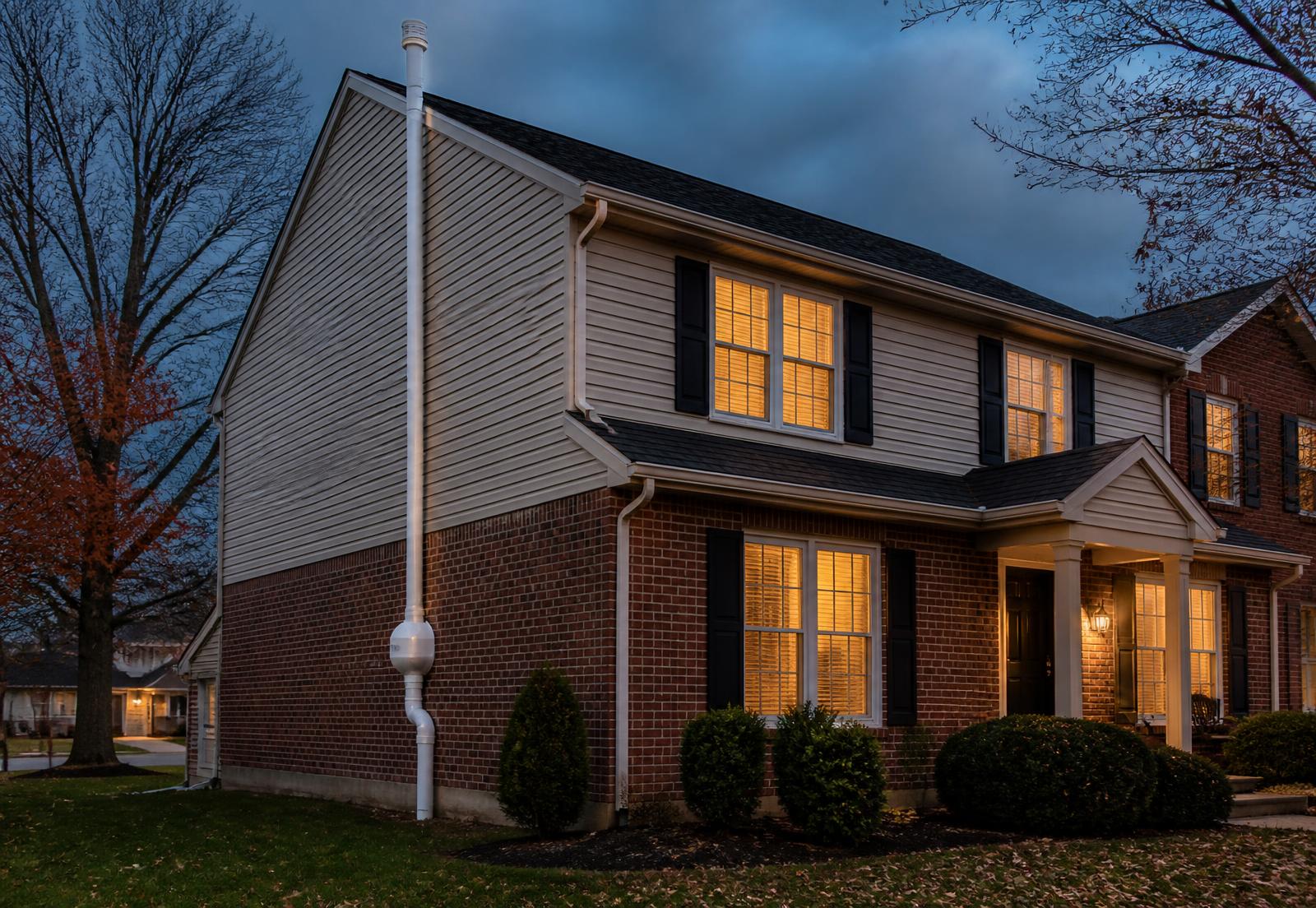
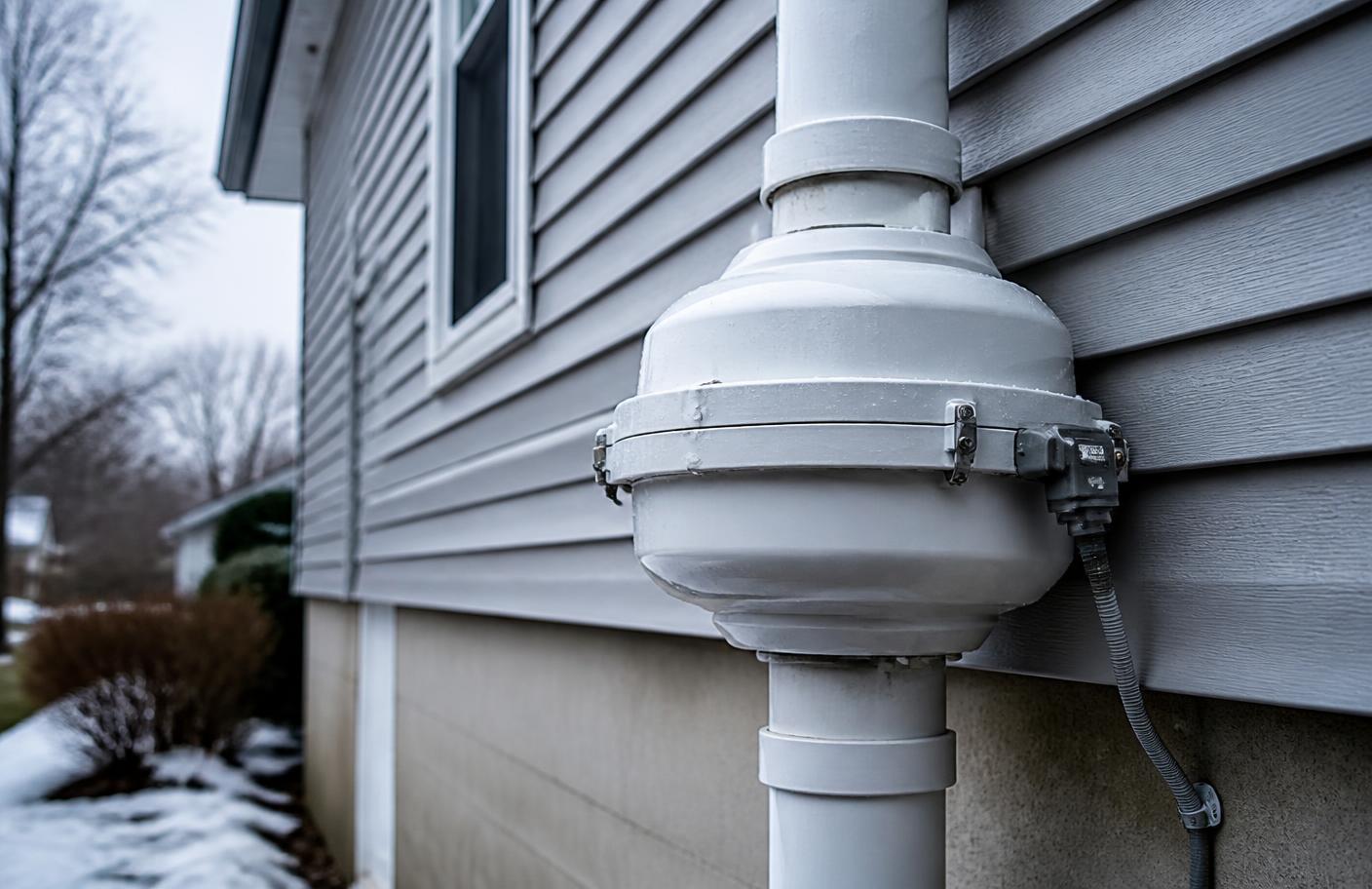
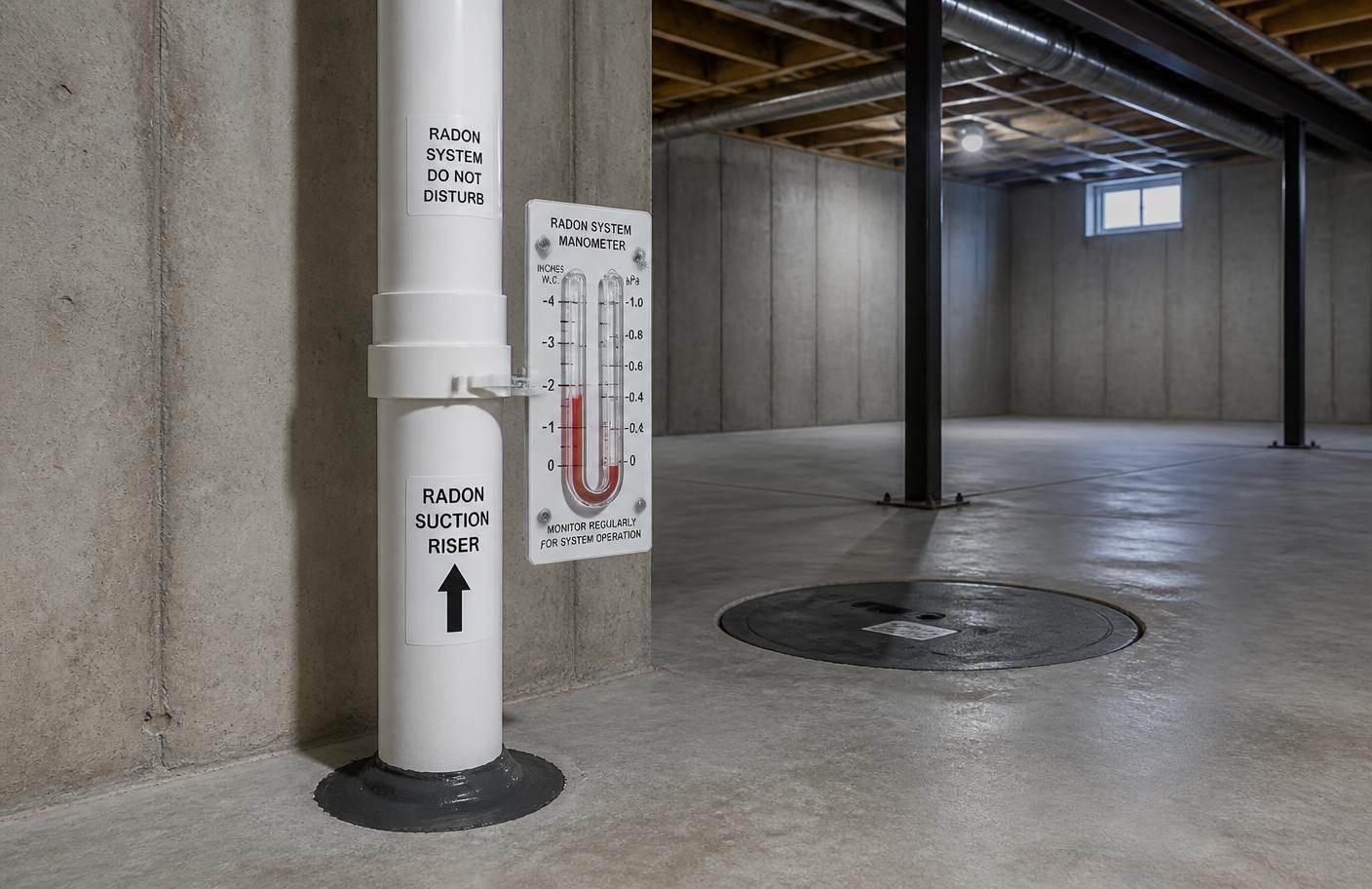
For most Indiana homes, mitigation means a sub-slab or sub-membrane depressurization system: a sealed pipe route from beneath the foundation to a roofline exhaust point, powered by an inline fan. System selection depends on foundation type, and homes with basements, crawl spaces or a combination often need different or combined approaches.
- EPA's action level is 4.0 pCi/L, with mitigation suggested to be considered between 2 and 4 pCi/L
- There is no known safe level of radon exposure, per EPA and CDC
- Short-term tests run about 48 hours under closed-house conditions; long-term tests run 90 days or more
- Mitigation systems generally cost roughly $800-$2,500 depending on foundation and complexity, confirmed by a site evaluation
Radon in Indiana Real Estate Transactions
Radon testing is commonly negotiated as part of Indiana home sales, though it is not universally mandated by state law. Indiana sellers complete a residential real estate sales disclosure form addressing known property conditions; whether and how radon results factor into that process should be confirmed with a real estate agent or attorney, since requirements and customary practice can vary by transaction and by county.
In practice, many purchase agreements include a radon contingency that allows buyers to test during an inspection period and negotiate mitigation if results come back elevated. Dedicated playbooks for each side of this process are covered in the Indiana Homebuyer Radon Guide, the Indiana Home Seller Radon Guide and the Indiana Real Estate Radon Guide for agents and investors.
Indianapolis and the Surrounding Counties
Marion County and the collar counties, Hamilton, Hendricks, Johnson, Boone, Hancock and others, share the underlying geology described above but differ in housing age and construction style. Indianapolis proper carries a mix of early-1900s bungalows, 1920s-40s two-story homes, mid-century ranches and newer infill, while suburban Hamilton and Hendricks County communities are dominated by post-2000 construction with more standardized foundation practices.
Those differences affect where radon pathways commonly appear and how a mitigation system gets routed and finished. The Indianapolis Radon Guide picks up that local detail in full, covering testing and mitigation practices by neighborhood and township.
Where to Verify Official Information
This page and the rest of the resource center are written as general reference material, not legal or medical advice. For authoritative, current information specific to Indiana, consult the Indiana Department of Health's Indoor and Radiologic Health program, which maintains the state's radon-related public health information, and the EPA's national radon program pages, which host the citizen's guide, the zone map and testing guidance referenced throughout this site.
When in doubt about a specific legal, disclosure or program question, the right sequence is usually: check the state and federal sources directly, then talk with a real estate professional or attorney for transaction-specific guidance, and use a qualified radon professional for the technical testing and mitigation work itself.
- Indiana Department of Health Indoor and Radiologic Health program for state-level radon information
- EPA's Citizen's Guide to Radon for the national testing and action-level framework
- A real estate agent or attorney for transaction-specific disclosure questions